
People Don’t Experience Landscape Design From Above
Everything may fit perfectly on a landscape plan.
The walkways are wide enough. The planting beds are in place. The pool has the right proportions.
That’s the gap landscape architects have to anticipate. Landscape architects spend years learning to translate two-dimensional information into three-dimensional space. We can look at a drawing and begin to imagine ourselves walking through it, understanding not only what each element represents, but how those elements will come together at full scale.
Not everyone looking at the plan can immediately picture the place it represents.
Landscape Design Starts With the User Experience
That thinking begins at the start of the design process.
Who is going to use this space? How will they arrive? What will they see first? Where will they walk? What should draw their attention? Where should they stop?
The answers can change the design considerably.
What Looks Good on a Plan Can Disappear at Ground Level
Viewed from directly overhead, a logo incorporated into paving might be perfectly proportioned and immediately recognizable. But put someone on the ground in the middle of it, and the design may become so large that they don’t even realize they’re standing on a logo.
The same principle applies throughout a landscape. What reads clearly from above may look or feel very different at eye level.
They’re going to experience it at eye level.
Great Landscape Design Builds Toward the Experience
Landscape architecture can also shape what someone sees and when they see it.
A view can be narrowed on approach, then opened to reveal a building, pool, lake, mountain, or other focal point. On a larger project, that sequence might begin at the entrance.
The entry monument establishes the first moment. The landscape along the road begins creating a sense of arrival.
Sometimes creating that moment requires detailed technical analysis. Other times, the opportunity becomes clear by experiencing the property firsthand. Either way, the goal is to recognize the views and moments that matter, then protect them as the design develops.
3D Landscape Design Brings the Experience Into Focus
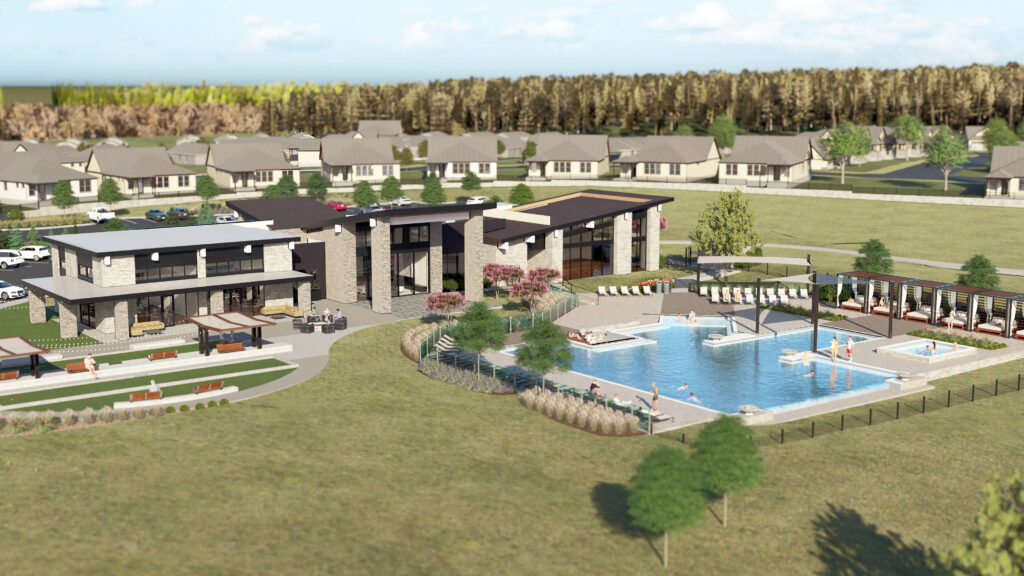
3D rendering was once primarily a presentation tool. Today, 3D landscape design and architectural visualization can become part of the design process itself, helping us study scale, sightlines, materials, planting, and spatial relationships before they’re built.
Visualization Gives Clients a Common Language
Not every client reads a plan the same way. Photographs, elevations, precedent images, and 3D landscape renderings can help clients see the design from a more familiar perspective and work through ideas with us in real time.
A 3D Rendering Should Show Something You Can Actually Build
Visualization can make almost anything look impressive.
That’s not the objective.
For us, the value of a 3D rendering comes from accurately communicating something that can become reality.
Proportions matter. Materials matter. Scale matters. Cost and constructability matter.
There are different levels of visualization depending on what we’re trying to accomplish. An early model may exist primarily to test spacing or sightlines. Later models may incorporate more accurate materials and details. A marketing fly-through may have a different purpose altogether.
But the underlying design still needs to hold up.
We want clients to be able to look at the finished project, pull up the plan or visualization they approved, and recognize what they were promised.
A beautiful image that can’t feasibly be built doesn’t accomplish that.
The goal isn’t to make the project look better than it is.
It’s to help everyone see what it can actually become.
Landscape Design Doesn’t Stop on Opening Day
There’s another complication when visualizing landscape architecture: the landscape keeps changing.
Plants are living materials.
They grow. Canopies expand. Spaces fill in. Views become more enclosed. Shade changes. Plants require trimming, irrigation, replacement, and ongoing care.
That means the landscape we design isn’t necessarily intended to look exactly the same on installation day as it will a year or two later.
Sometimes a client needs a landscape to appear established almost immediately. Other projects allow plant material time to mature into the intended condition.
Designing the finished experience therefore means thinking beyond the grand opening.
We’re designing for what the landscape can become.
Technology Still Needs a Landscape Architect
The tools will continue to get better.
AI can already help produce concepts and imagery faster. Modeling and site technology give us more information earlier in the process. But information isn’t judgment. Landscape architects still have to determine what serves the site, the client, and the people who will ultimately experience it.
The landscape architect still has to make those decisions.
From a 1,000-Acre Plan to a 10-Foot Garden
Landscape architecture works across an unusually wide range of scales.
Within the same project, our landscape architects may eventually be considering a 10-by-10-foot garden inside a courtyard.
Both decisions influence the experience of the place.
One establishes the larger framework. The other brings that experience down to the scale of the person who will actually use it.
That’s why landscape architecture can operate everywhere from a mile-long arrival sequence to the details someone notices while sitting in a garden.
Designing What People Will Actually Experience
A successful landscape has to work on paper.
It needs to meet technical requirements. It needs to function. It needs to be buildable.
But that’s only part of the job.
People won’t experience the finished project by looking straight down at it from above. They’ll approach it in a car. Walk through it on foot. Sit beneath its trees. Follow its paths. Notice some details and completely miss others.
They’ll experience the landscape in motion, at eye level, and over time.
Our job as landscape architects is to anticipate those moments before they exist.
The tools we use to do that have changed dramatically. The objective hasn’t.
Design the plan so the experience works when it leaves the page.
From Concept to Experience
SEC Planning combines thoughtful landscape architecture with visualization tools that help clients understand what a design can become before it’s built.